Which technologies are currently most widely used for sensor-based SHM?
Structural Health Monitoring (SHM) is a technology used to continuously or periodically monitor the condition, load, and structural integrity of structures. With the help of sensors, changes in vibration, deformation, stress, inclination angle, and temperature can be recorded.
SHM is increasingly being applied to bridges, tunnels, buildings, wind turbines, industrial installations, storage tanks, and infrastructure . The goal is to identify deviations early, plan maintenance better, and improve the safety and availability of structures.
The most commonly used sensor technologies for SHM are:
- Strain gauges.
- Accelerometers and vibration sensors.
- Inclinometers and tilt angle sensors.
- Displacement sensors.
- Fiber optic sensors (Fiber Bragg Grating).
- Temperature sensors.
- Acoustic emission sensors.
- Ultrasonic sensors.
- GNSS and geodetic measurement systems.
- Wireless sensor networks.
Which technology is most suitable depends on the construction, the desired measurement objective, the measurement accuracy, the measurement frequency, and the environmental conditions.
WiSeNode offers wireless sensor technology and Industrial IoT solutions that allow various types of sensors to be integrated into a single monitoring architecture.
What is sensor-based Structural Health Monitoring?
Sensor-based Structural Health Monitoring is the systematic measurement and analysis of the physical properties of a structure.
By placing sensors at strategic locations, changes can be monitored that may indicate:
- Increasing mechanical load.
- Unwanted vibrations.
- Deformation of structural elements.
- Relocation of foundations.
- Tilt.
- Material fatigue.
- Temperature influences
- Possible cracking.
- Changes in dynamic properties.
- Deterioration of the structural condition.
An SHM system typically consists of sensors, measurement electronics, data communication, data storage, and software for analysis and visualization.
Important: SHM sensors typically measure physical changes. Determining actual structural damage requires a suitable analysis method, reference measurements, and, where necessary, additional inspection.
Why is sensor-based SHM becoming increasingly important?
Traditionally, structures are visually inspected periodically. Although these inspections remain important, they do not always provide insight into what happens between inspection moments.
Sensor-based monitoring makes it possible to:
- To monitor structures for extended periods.
- To analyze tax patterns.
- To detect changes early.
- To plan maintenance better.
- To carry out inspections in a more targeted manner.
- To compare historical measurement data.
- To investigate the effects of traffic, wind, and temperature.
- The remaining service life can be better assessed in combination with structural models.
For managers of critical infrastructure, this can contribute to a more data-driven maintenance strategy.
1. Strain gauges for SHM
Strain gauges are among the most widely used sensors for measuring local deformations in structures.
A strain gauge measures the relative change in length of a material under load.
When a structural part is loaded, a small deformation occurs. This deformation changes the electrical resistance of the strain gauge.
With suitable measuring electronics, this change is converted into a measured value, usually expressed in microstrain (µε).
What do strain gauges measure?
- Tensile deformation.
- Compression distortion.
- Bending deformation.
- Dynamic stretch.
- Fatigue load.
- Local voltage changes.
Stress can be calculated from the measured strain under certain conditions using the material properties.
Applications
Strain gauges are used for:
- Bridge structures
- Steel load-bearing structures.
- Wind turbines
- Cranes.
- Industrial machines
- Storage tanks.
- Offshore structures.
- Structural connections.
Benefits
- High sensitivity to minor distortions.
- Suitable for static and dynamic measurements.
- Compact sensors.
- Suitable for long-term monitoring.
- Compatible with wireless measurement modules.
Wireless rack measurements with WiSeNode
With a suitable wireless measurement module, signals from strain gauges can be collected and forwarded to a gateway.
This can limit the amount of long signal cables and is interesting for constructions where cabling is difficult or expensive.
2. Accelerometers and vibration sensors
Accelerometers are among the most important sensors for dynamic Structural Health Monitoring.
An accelerometer measures accelerations caused by vibrations or movements of a structure.
These measurement data can be used to investigate the dynamic properties of a structure.
What do accelerometers measure?
- Vibration acceleration.
- Vibration frequencies.
- Dynamic response.
- Resonance behavior.
- Changes in natural frequencies.
- Vibration patterns.
With suitable signal processing, displacements and velocities can also be derived, although measurement errors and drift may occur.
Applications
Accelerometers are widely used in:
- Bridges.
- High-rise
- Wind turbines
- Rail infrastructure.
- Industrial machines
- Offshore structures.
- Towers.
- Chimneys.
- Large steel structures.
Why are vibration measurements important?
Structures have characteristic dynamic properties, such as natural frequencies and waveforms.
Changes in this can be caused by, among other things:
- Changes in stiffness.
- Changing tax.
- Temperature.
- Mass.
- Changes in connections.
- Possible structural damage.
Therefore, vibration measurements must always be interpreted in the correct context.
Wireless accelerometers
Wireless accelerometers can record measurement data locally and then transmit it to a central gateway.
For accurate dynamic analyses, synchronization, sampling frequency, and data quality are important, among other things.
3. Inclinometers and tilt angle sensors
An inclinometer measures the angle of inclination or tilt of an object relative to a reference direction.
This technology is widely used when slowly changing structural movements need to be tracked.
What do inclination sensors measure?
- Angle of inclination.
- Tilting.
- Tilt.
- Slow rotation.
- Changes in structural position.
Applications
- Bridge piers.
- Buildings.
- Foundations
- Retaining walls.
- Checkers.
- Towers.
- Storage tanks.
- Industrial structures.
- Construction pits.
Why use inclination sensors?
A small change in angle of inclination can indicate displacement or deformation of a structure.
By measuring over a long period, trends can become visible that are difficult to recognize during a one-off inspection.
Wireless inclination measurement
A wireless inclination sensor can periodically register an angle of inclination and transmit it to a monitoring system.
This is particularly interesting for long-term monitoring of hard-to-reach structures.
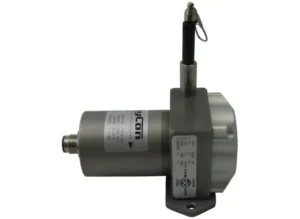
4. Displacement sensors
Displacement sensors measure changes in position or distance between two points.
Within SHM, they are used to register relative movements of structural elements.
Widely used technologies
- LVDT displacement sensors.
- Inductive sensors.
- Laser distance sensors.
- Linear encoders.
- Ultrasonic distance sensors.
- Radar distance sensors.
Applications
- Bridge joints
- Expansion joints.
- Bearing structures.
- Crack monitoring.
- Foundations
- Steel structures.
- Concrete structures.
- Industrial installations.
What can motion sensors show?
They can make changes visible in:
- Joint width
- Relative structural movement.
- Deflection.
- Thermal expansion.
- Position of structural elements.
The appropriate technology is selected based on measuring range, accuracy, mounting, and environmental conditions.
5. Fiber Optic Sensors (Fiber Bragg Grating)
Fiber Bragg Grating (FBG) is an optical sensor technology used to measure strain and temperature, among other things.
In FBG sensors, a special structure is incorporated into an optical fiber. This reflects light within a specific wavelength range.
When the fiber is stressed or the temperature changes, the reflected wavelength shifts.
Advantages of FBG sensors
- High sensitivity.
- No electrical signals at the measurement point.
- Insensitive to electromagnetic interference.
- Multiple measurement points on a single optical fiber are possible.
- Suitable for long measurement routes.
- Interesting for large infrastructure projects.
Applications
- Bridges.
- Tunnels
- Checkers.
- Wind turbines
- Offshore structures.
- Composite materials.
- Large steel structures.
FBG systems typically require specialized optical readout equipment.
For some projects, a combination of fiber optic measurements and wireless electronic sensors can be interesting.
6. Temperature sensors
Temperature measurements are an important part of many SHM systems.
Structures expand and contract due to temperature changes. This can cause deformations that are not directly related to damage.
Why measure temperature?
Temperature data helps with:
- Compensation of strain measurements.
- Interpretation of displacements.
- Analysis of thermal load.
- Comparison of seasonal influences.
- Research into material behavior.
- Correction of certain sensor anomalies.
Applications
- Bridges.
- Concrete structures.
- Steel structures.
- Storage tanks.
- Wind turbines
- Industrial installations.
Temperature sensors are therefore often combined with strain gauges, inclination sensors, and displacement sensors.
7. Acoustic emission sensors
Acoustic emission is a technology used to record short-duration elastic waves generated by processes within a material.
Think of:
- Crack growth.
- Local material fracture.
- Friction phenomena.
- Certain fatigue processes.
How does acoustic emission work?
Sensitive sensors are placed on a structure and register high-frequency signals.
By analyzing these signals, active events can be investigated.
Applications
- Pressure vessels.
- Storage tanks.
- Bridges.
- Composite structures.
- Industrial piping.
- Offshore structures.
Acoustic emission can be valuable for damage investigation, but requires specialized signal analysis and differentiation between relevant signals and ambient noise.
8. Ultrasonic sensors
Ultrasonic measurement methods use sound waves with frequencies above the human hearing range.
In structural monitoring, ultrasonic techniques are used, among other things, to investigate material properties and possible internal anomalies.
Applications
- Wall thickness measurement.
- Corrosion investigation.
- Crack testing.
- Weld inspection.
- Concrete research.
- Pipeline inspection.
- Storage tank inspection.
Difference between ultrasonic and acoustic emission
In ultrasonic inspection, a sound signal is typically actively introduced into the material.
Acoustic emission specifically registers signals originating from the material itself.
Specialized ultrasonic systems are available for continuous monitoring, depending on the application.
9. GNSS and geodetic measurement systems
For large structures and infrastructure, GNSS systems can be used to measure displacements.
GNSS stands for Global Navigation Satellite System.
With suitable receivers and correction techniques, movements of structures can be monitored over longer periods.
Applications
- Large bridges.
- Checkers.
- High-rise
- Landslides.
- Foundations
- Major infrastructure projects.
GNSS is particularly interesting when absolute or relative displacements over longer distances need to be determined.
For very small local distortions, other sensor technologies are often more suitable.
10.Wireless Sensor Networks (WSN)
A Wireless Sensor Network is a network of wireless measurement modules that collect data and communicate with a central gateway.
WSN is not a separate physical measurement principle, but a communication technology that allows different sensor types to be combined.
A wireless SHM network can, for example, consist of:
- Strain gauge modules.
- Accelerometers.
- Inclination sensors.
- Temperature sensors.
- Displacement sensors.
- Wireless gateways
- Cloud software.
- Analysis and alarm systems.
Why use wireless sensor networks?
Traditional SHM systems often use long signal cables.
For large structures, the costs of cabling, installation, and maintenance can be substantial.
Wireless systems can offer benefits such as:
- Less cabling.
- Faster installation.
- Flexible sensor placement.
- Simpler expansion.
- Monitoring at hard-to-reach locations.
- Central data collection.
- Integration with Industrial IoT platforms.
What requirements must a wireless SHM system meet?
Important points of attention are:
- Wireless range.
- Reliability of data communication.
- Battery life.
- Sampling frequency.
- Time synchronization.
- Data storage.
- Cybersecurity.
- Environmental resilience.
Higher requirements may apply to high-frequency vibration measurements than to periodic temperature or inclination angle measurements.
Which SHM sensor technology is most suitable?
The best technology depends on what you want to measure.
| sensor technology | Key measurement value | Typical application |
|---|---|---|
| Strain gauges | Stretch and deformation | Bridges, steel structures |
| Accelerometers | Vibrations and acceleration | Bridges, towers, wind turbines |
| Inclinometers | Inclination angle | Buildings, foundations |
| Displacement sensors | Distance and travel | Joints, structural elements |
| FBG fiber optic sensors | Rack and temperature | Major infrastructure |
| Temperature sensors | Temperature | Thermal compensation |
| Acoustic emission | Acoustic events | Crack and material testing |
| Ultrasonic sensors | Ultrasonic response | Wall thickness and material inspection |
| GNSS | Position and movement | Bridges, dams, high-rise buildings |
| Wireless Sensor Networks | Wireless data transfer | Distributed SHM monitoring networks |
For many practical SHM projects, strain gauges, accelerometers, inclinometers, and temperature sensors form a strong foundation. However, the right combination depends on the failure mechanisms to be monitored and the desired measurement results.
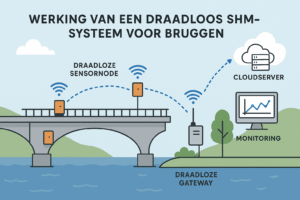
How does a wireless SHM system work with WiSeNode?
A wireless SHM solution can be built from sensors, measurement modules, gateways, and a central data platform.
Step 1 – Placing sensors
Sensors are mounted at strategic locations, for example on:
- Bridge girders
- Columns.
- Foundations
- Steel connections.
- Wind turbines
- Industrial load-bearing structures.
Step 2 – Collect measurement data
The sensors register, for example, strain, vibrations, angle of inclination, or temperature.
Step 3 – Wireless data transfer
A suitable wireless measurement module transmits the measurement data to a gateway.
Step 4 – Central data processing
The gateway makes the data available to a local system or cloud platform, depending on the chosen architecture.
Step 5 – Analysis and visualization
Measurement data can be used for:
- Graphs.
- Trend analysis
- Alarm limits.
- Historical comparisons.
- Reports.
- Maintenance analyses.
Step 6 – Maintenance decisions
Based on trends, limit values, and structural assessment, inspections and maintenance can be planned in a more targeted manner.
Applications of Structural Health Monitoring
SHM for bridges
In bridges, accelerometers, strain gauges, temperature sensors, and displacement sensors are often combined.
This allows loading, vibration behavior, and structural movements to be investigated.
SHM for buildings
In buildings, inclination sensors and accelerometers can be used to monitor tilt, vibrations, and structural movements.
SHM for wind turbines
Wind turbines are exposed to varying loads due to wind, rotation, and operating conditions.
Sensors can be used to monitor vibrations, deformations, and dynamic loading.
SHM for industrial structures
For industrial installations, SHM can be of interest for:
- Cranes.
- Storage tanks.
- Steel structures.
- Transport installations.
- Platforms.
- Large machine foundations.
SHM for tunnels and dams
In tunnels and dams, displacement, temperature, strain, and angle of inclination can be monitored.
In this regard, various sensor technologies can complement each other.
Integration of SHM with Industrial IoT
By combining SHM with the Industrial Internet of Things (IIoT), measurement data can be made centrally available.
A possible architecture consists of:
Sensor → wireless measurement module → gateway → local network or cloud → dashboard and analysis
Depending on the application, the data can be integrated with:
- Asset management software.
- Maintenance management systems.
- SCADA.
- Industrial databases.
- Analysis platforms.
- Digital twins.
The available integration options depend on the chosen hardware, communication protocols, and software.
Custom SHM solutions
No two structures are the same.
For a good SHM solution, the following questions, among others, must be answered:
- Which structure needs to be monitored?
- Which possible damage or failure mechanisms are relevant?
- Which measurement values are needed?
- How many measurement points are required?
- What accuracy is necessary?
- How often should measurements be taken?
- Is continuous or periodic monitoring desired?
- Are the sensors placed outside?
- Is battery power necessary?
- What wireless distance needs to be covered?
- Should alarms be generated?
- Is integration with existing software necessary?
WiSeNode can assist in selecting a suitable wireless sensor architecture.
Security, reliability and data quality
For reliable Structural Health Monitoring, the sensor is not the only important factor.
The quality of the entire measurement chain also determines whether the data are usable.
Important points of attention are:
- Correct sensor mounting.
- Calibration.
- Temperature compensation.
- Measurement frequency
- Time synchronization.
- Battery monitoring
- Data loss detection.
- Secure data transfer.
- Periodic system check.
- Validation of alarm limits.
For safety-critical applications, SHM must be part of a broader inspection and maintenance strategy.
Service and maintenance of SHM systems
Wireless sensor networks also require periodic inspection.
Possible tasks include:
- Sensor check.
- Inspection of fastenings.
- Battery status check.
- Checking wireless connections.
- Gateway control.
- Calibration or verification.
- Software updates.
- Verification of measurement data.
- Failure analysis.
- Expansion of measuring points.
Proper maintenance helps ensure the continuity and reliability of the monitoring system.
Why choose WiSeNode and DEXMAN?
WiSeNode focuses on wireless sensor technology and Industrial IoT solutions for industrial and infrastructure applications.
In combination with the technical expertise of DEXTOOLS and Bienfait, support can be provided for:
- Selection of SHM sensors.
- Wireless measurement modules.
- Strain measurements.
- Vibration measurements.
- Inclination angle measurements.
- Temperature monitoring.
- Gateway solutions.
- Data collection.
- Integration with existing systems.
- Technical advice.
- Custom sensor architectures.
This enables the development of sensor-based SHM solutions that align with the structure, measurement objectives, and operating environment.
Frequently asked questions about sensor-based SHM
What does SHM mean?
SHM stands for Structural Health Monitoring. It involves monitoring the condition and behavior of structures using sensors, data collection, and analysis.
Which sensors are most commonly used for SHM?
Commonly used sensors are strain gauges, accelerometers, inclinometers, displacement sensors, and temperature sensors. For specialized applications, fiber optic, ultrasonic, and acoustic emission sensors are also used.
Which sensor is suitable for bridge monitoring?
For bridges, a combination of accelerometers, strain gauges, temperature sensors, and displacement sensors is often used. The correct choice depends on the structure and the desired measurement objective.
What is the difference between a strain gauge and an accelerometer?
A strain gauge measures local deformation of a material. An accelerometer measures acceleration and vibrations of a structure.
What is a wireless SHM system?
A wireless SHM system collects measurement data via sensors and wireless measurement modules and transmits it to a gateway or central monitoring system.
Can SHM detect structural damage?
SHM can measure changes that may indicate damage. Suitable analytical methods and often additional inspections are required to reliably determine damage.
Is wireless SHM accurate?
Wireless SHM can be accurate when sensors, measurement electronics, calibration, synchronization, and communication are correctly aligned with the application.
Can SHM sensors run on batteries?
Yes. Many wireless sensor modules can run on batteries. Battery life depends on, among other things, measurement frequency, data transfer, and energy consumption.
Is continuous monitoring possible?
Yes. Depending on the chosen hardware and measurement architecture, measurements can be performed continuously or periodically.
Which sensors are used for crack monitoring?
For crack monitoring, displacement sensors, strain gauges, fiber optic sensors, and specialized acoustic or ultrasonic techniques can be used, among others.
Which SHM technology is suitable for wind turbines?
Accelerometers, strain gauges, and temperature sensors are widely used for analyzing vibrations, deformations, and dynamic loading.
Can SHM be linked to a cloud platform?
Yes. Measurement data can be transmitted to a cloud platform via gateways and suitable communication connections for visualization and analysis.
What is the advantage of Wireless Sensor Networks?
Wireless sensor networks reduce the need for long cable runs and make it easier to install and expand distributed measurement points.
Can WiSeNode combine multiple sensor types?
Depending on the selected measurement modules and interfaces, various sensor types can be combined within a single wireless monitoring architecture.
How much does an SHM system cost?
The costs depend on the number of measurement points, sensor types, measurement accuracy, communication technology, installation, software, and desired analysis capabilities.
Advice on Sensor-Based SHM and Wireless Sensor Technology
Do you want to monitor a bridge, building, wind turbine, industrial structure, or other critical infrastructure with sensors?
WiSeNode and DEXMAN assist in selecting suitable technologies for Structural Health Monitoring , including strain gauges, accelerometers, inclinometers, and wireless sensor networks.
We look at the complete measurement solution: from sensor selection and measurement electronics to wireless data transmission, gateways, and integration with a central monitoring system.
Contact WiSeNode or DEXMAN for technical advice on wireless SHM sensors and a customized monitoring solution.

Data acquisition systems in the construction sector
In the dynamic world of the construction industry, data acquisition systems (DAQ) are essential for effectively monitoring, managing, and optimizing construction projects. These systems enable construction companies to collect crucial data from various sources, such as sensors, machines, and measuring instruments, thereby gaining better insight into their operational processes.
Dexman
We at Dexman know better than anyone that the right information is the most important thing. Because if a measurement is not correct, the solution is of no use to you. This applies not only to the solutions we offer, but also to the way in which we communicate. At Dexman, we stand for quality, service and solution orientation. In this, it is important to provide the right information, offer a good solution and be honest with each other.
Dexman is a supplier with a wide range of load cells , weighing platforms , pallet scales , crane scales , force sensors , torque meters , measuring amplifiers , pressure sensors , and displacement sensors . You can come to us for standard versions, as well as custom-made components and complete weighing solutions. In most cases, choosing the right components begins with comprehensive advice.
We are active in the following sectors, among others: offshore, aerospace, logistics, agriculture, food, and pharma. Thank you for your interest in Dexman's products and services. We look forward to the opportunity to be of service to you.
Contact
If you would like to receive more information or a quotation, please feel free to contact us.